kaybin
Engineering Plastic Billets
Engineering Plastic Billets
Or email us directly at info@kaybin.co.za with the product name and quantity.
Engineering Plastic Billets for Heavy-Duty Machined Components
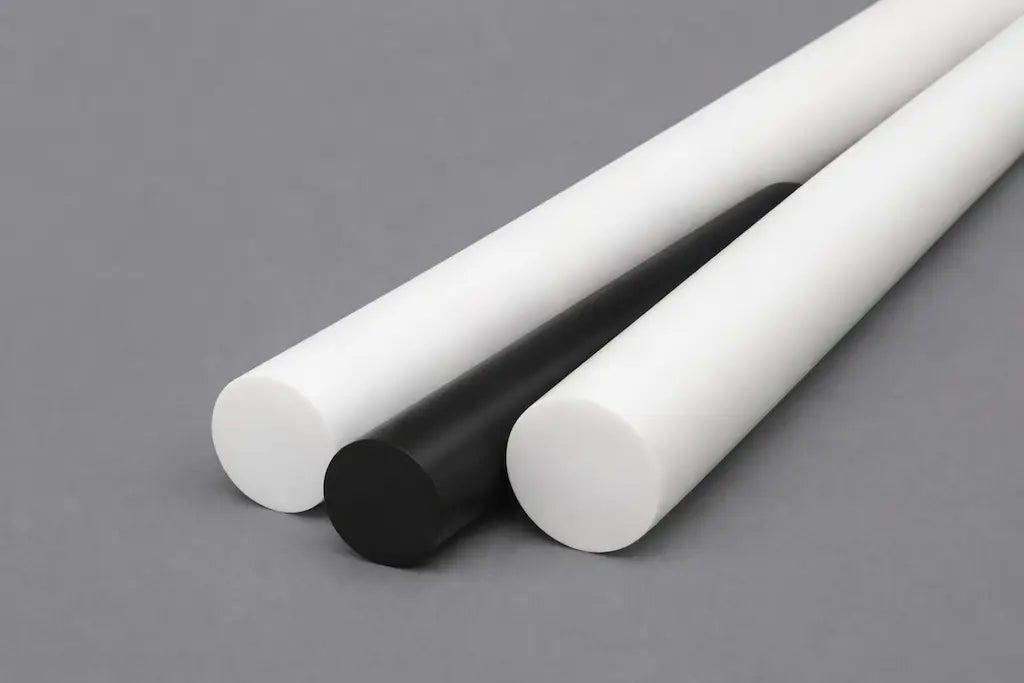
Kaybin supplies and machines engineering plastic billets as solid stock for heavy-duty, precision parts. Billets provide oversized, stable material that can be turned, milled or profiled into complex components where strength, dimensional stability, wear resistance or corrosion resistance are critical.
This page covers engineering plastic billets, not steel or aluminium billets.
Billets are used where standard rod, sheet or tube sizes are not sufficient, and where polymer can replace metal to reduce weight, eliminate galling, improve corrosion resistance or provide electrical insulation.
Function & Typical Applications
- Large or complex machined parts that cannot be cut from standard rod, sheet or tube
- Components requiring wall thickness and rigidity for structural or loaded duty
- One-piece parts where joints or welds would weaken the design
Typical billet-machined components include:
- Heavy-duty bushes, sleeves and wear blocks
- Manifolds, spacer blocks and structural mounts
- Scraper blades, shut-off blocks, rollers and custom profiles
- Liners, impact pads and guides for bulk materials handling
- General OEM parts in mining, materials-handling, packaging, food, chemical and process equipment
Billets can be supplied as raw plastic billet stock for your own machining or as fully machined finished components to drawing or sample.
Material Options & Behaviour
PTFE (Virgin & Filled Grades)
Very low friction and excellent chemical resistance. Filled grades improve wear resistance and reduce creep compared to virgin PTFE, making them suitable for bearing-grade parts.
Nylon (Natural, Oil-Filled, Glass-Filled)
Natural and oil-filled grades provide high strength, impact resistance and wear performance. Glass-filled grades offer higher stiffness and dimensional stability but reduced impact toughness. Nylon absorbs moisture; dimensional allowance is reviewed during tolerance planning.
Acetal / POM
Low moisture absorption, tight tolerance capability and good dimensional stability. Frequently selected where accurate fits and stable machining performance are required.
Polyurethane (PU Elastomer)
High impact and abrasion resistance. Used where resilience and shock loading performance are more critical than ultra-tight dimensional tolerance.
UHMWPE / HDPE
Very high abrasion resistance and low friction for liners and wear blocks in bulk-handling applications. Lower stiffness compared with nylon or acetal.
Polypropylene (PP)
Lightweight and chemically resistant in compatible processes requiring moderate stiffness.
Static-dissipative, electrically insulating, UV-stabilised or compliance-reviewed grades (e.g. food-contact or FR/FRAS) are evaluated only upon request and confirmed during material selection.
Compared with steel, these polymers offer significantly lower density, reduced handling weight and elimination of metal-on-metal galling in sliding applications.
Size, Machining & Fit Considerations
- Supplied in sizes matched to part geometry and machining capacity
- Machining allowance considered for surface finish and dimensional clean-up
- Suitable for CNC turning, milling, boring and drilling
- Multi-axis machining available for complex geometries where required
Machining parameters are selected to manage heat build-up in temperature-sensitive polymers. Tolerances are agreed per component, accounting for thermal expansion, creep behaviour, moisture absorption and expected service temperature.
Press-fit vs clearance-fit conditions are reviewed per material. Threaded features, inserts, counterbores and bonded interfaces can be incorporated into billet-based components where required.
Billets may be extruded or cast depending on material and section size. Stress relief and machining strategy are used to minimise distortion and improve dimensional stability.
Where multiple components are machined from a billet, nesting and layout strategies can optimise material usage.
Share