kaybin
Plastic Nuts & Bolts (Engineering Plastic Fasteners)
Plastic Nuts & Bolts (Engineering Plastic Fasteners)
Or email us directly at info@kaybin.co.za with the product name and quantity.
Plastic Nuts & Bolts (Engineering Plastic Fasteners)
Kaybin manufactures custom plastic nuts and bolts, engineering plastic fasteners and non-metallic fasteners for industrial and OEM applications where corrosion resistance, chemical resistance, electrical insulation, and lightweight fixing are required.
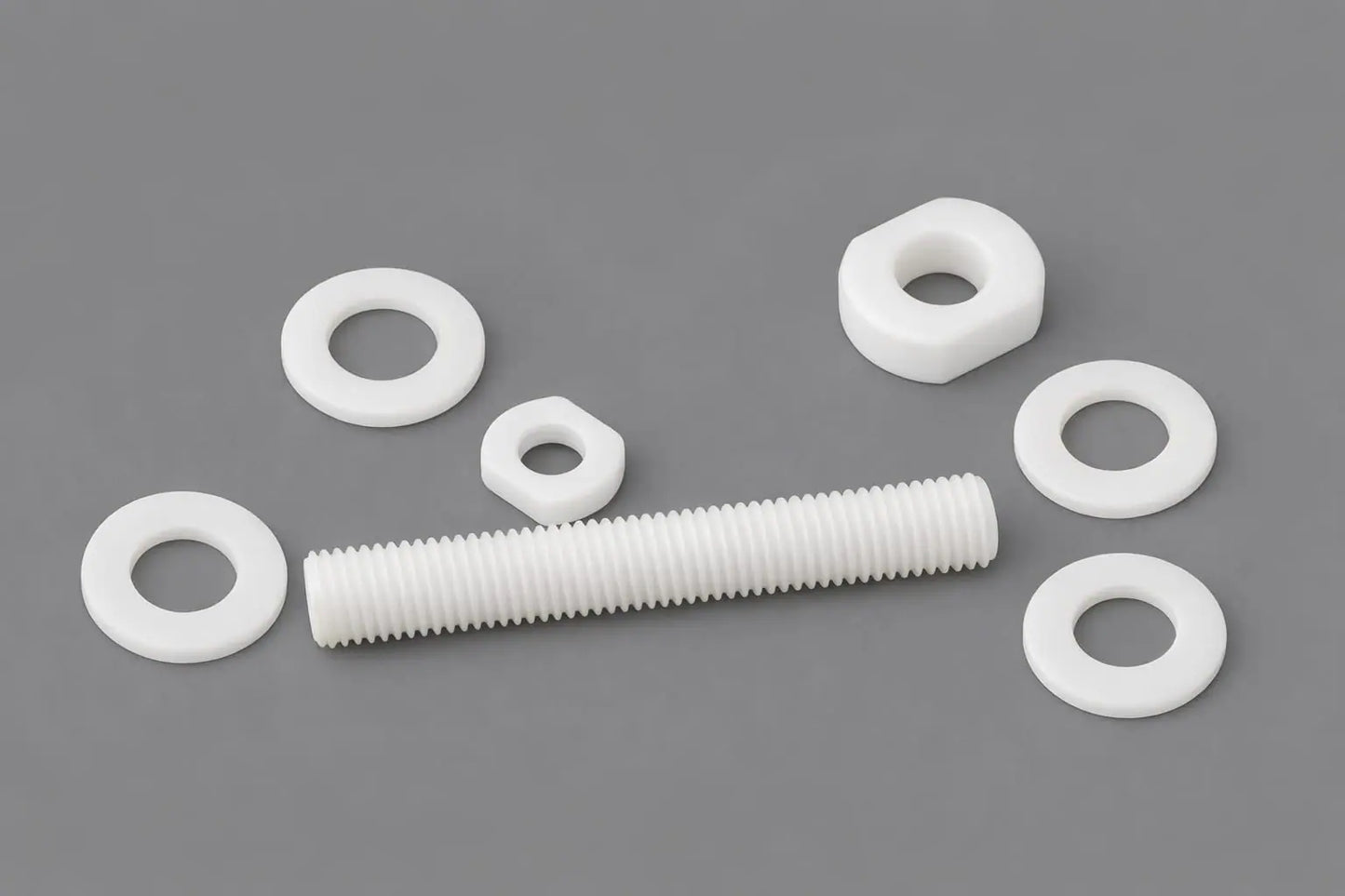
Fasteners are supplied as machined plastic bolts, plastic screws, plastic nuts, plastic washers, plastic spacers and plastic threaded rods, produced to drawing, specification, or matched from samples for replacement plastic fasteners and discontinued OEM hardware.
Industrial use only — this page covers engineered polymer fasteners, not decorative consumer hardware.
Common Industrial Applications
- Chemical plant fasteners and washdown equipment (material dependent)
- Water treatment, dosing skids, and corrosive utility environments
- Food processing fasteners (material/grade dependent; reviewed per requirement)
- Marine equipment where corrosion and galvanic issues occur
- Electrical enclosures and non-conductive fastening requirements
- Packaging lines and OEM equipment requiring lightweight, non-sparking hardware
Fastener Types & Configurations Manufactured
- Plastic hex bolts, plastic cap screws, plastic socket head bolts
- Plastic set screws, plastic studs, plastic threaded rod
- Plastic nuts (hex, flange, wing, lock-nut styles where applicable)
- Plastic washers, plastic spacers and custom insulating bushes
- Custom head forms, shank lengths, under-head features, and thread runout control
Thread Forms, Sizes & Common Modifiers
Industrial fastener searches heavily include size modifiers. Kaybin can manufacture to common metric and imperial threads, confirmed from your mating part, drawing, or sample.
- Metric plastic bolts: M4, M6, M8, M10, M12 (and others)
- Imperial plastic fasteners: 1/4", 3/8" threaded forms (and others)
- Thread pitch: coarse or fine thread (as specified)
- Thread engagement: reviewed for clamp load and stripping risk (material dependent)
Material Options (Selected Per Duty)
Plastic fastener performance is material-dependent. Fastener grade is selected based on chemical exposure, temperature variation, load, and installation torque requirements.
- Nylon fasteners (PA6 / PA66) – tough, widely used; moisture absorption and dimensional shift reviewed
- Glass-filled nylon bolts – higher stiffness for stronger clamp retention (application dependent)
- PTFE fasteners (virgin / filled) – excellent chemical resistance and low friction; cold-flow behaviour reviewed
- Acetal / POM fasteners – good dimensional stability and machinability
- Polypropylene (PP) and PVDF – chemical service compatibility (media dependent)
- UHMW / HDPE – lighter-duty corrosion resistant applications
- PEEK fasteners – high-performance applications where specified (duty dependent)
Engineering Performance & Specification Considerations
Engineering plastic fasteners are selected with attention to:
- Tensile vs shear loading (load path identification)
- Clamp load and thread engagement length
- Creep behaviour under sustained clamp force (polymer-dependent)
- Thermal expansion effects on joint preload
- Moisture absorption effects (nylon-dependent)
- Chemical compatibility and washdown exposure
- UV exposure (if outdoor use is relevant)
Common Failure Modes
Fastener failures are usually application-driven. Common issues include:
- Plastic bolt shearing under overload or impact
- Thread stripping from insufficient engagement or over-torque
- Nylon bolt creep / stretching and loss of clamp load over time
- PTFE cold-flow leading to loosening (grade dependent)
- Thermal expansion causing joint relaxation
- Cracking from chemical attack or stress concentration
Material selection and joint design review (engagement length, washer use, clamp geometry) reduce repeat failures.
Plastic vs Stainless / Brass Fasteners
- Plastic fasteners: corrosion resistant, electrically insulating, lightweight, non-sparking (material dependent)
- Metal fasteners: higher structural capacity and temperature tolerance, but may corrode or create galvanic issues
Final selection depends on the duty, environment and joint requirements.
Replacement & OEM Manufacturing Support
- Replacement plastic bolts and plastic nut sets
- Custom threaded plastic bolts (non-standard lengths/head forms)
- OEM plastic fasteners and small-batch production
- Reverse engineering from worn samples where drawings are unavailable
Manufactured in South Africa for industrial and OEM supply across Africa.
Engineering Details Required
To quote and manufacture the correct fasteners, provide:
- Fastener type (bolt, screw, nut, washer, spacer, threaded rod)
- Thread form and size (metric/imperial) + pitch (if known)
- Length, head style, and under-head features
- Load type (tension/shear) and duty severity (light/medium/heavy)
- Environment (chemical exposure, washdown, UV/outdoor, temperature range)
- Clamp requirement and mating material (plastic/metal interface)
- Drawing/CAD or a sample fastener (preferred)
Kaybin then selects the correct engineering polymer grade and manufactures plastic nuts and bolts to specification for reliable industrial fastening.
FAQ
- Are nylon bolts strong? Nylon bolts can handle many light-to-medium duties, but clamp load and creep must be considered for sustained joints.
- When should PTFE fasteners be used? PTFE is chosen for chemical resistance and low friction where cold-flow behaviour is acceptable or controlled by design.
- Do plastic fasteners corrode? Polymer fasteners do not rust, making them useful in wet and chemical environments (material compatibility still matters).
Share