kaybin
Union & Sanitary Seals
Union & Sanitary Seals
Or email us directly at info@kaybin.co.za with the product name and quantity.
Hygienic Process Pipe & Industrial Union Sealing Solutions
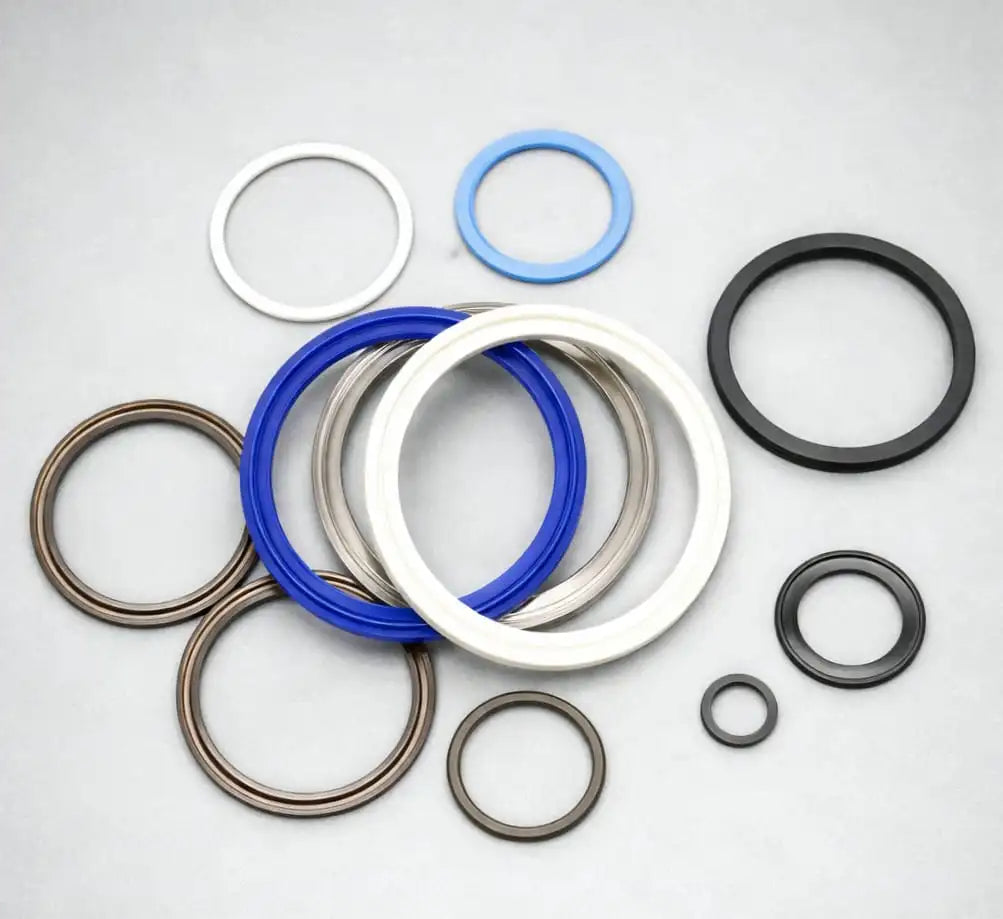
Kaybin manufactures custom union seals and sanitary seals for hygienic and industrial process piping systems where leak-free, repeatable static sealing is critical. Seals are moulded or machined to recognised standards (Tri-Clamp, SMS, RJT, DIN 11851, BSP/NPT unions) or reverse engineered from samples to ensure accurate compression and reliable performance in process plants across South Africa and Africa.
This page covers static hygienic and process union sealing only — not hydraulic cylinder seals (reciprocating motion) and not rotary shaft oil seals.
Function & Applications
- Compressed static sealing between ferrules and union faces
- Maintains hygienic integrity in CIP and SIP systems
- Supports dismantlable pipe connections for maintenance and product changeover
- Compensates for minor misalignment and thermal cycling
- Protects stainless ferrule faces from metal-to-metal damage
Commonly used in:
- Food & beverage production lines
- Dairies and breweries
- Pharmaceutical and cosmetic plants
- Chemical processing systems
- Water treatment and hygienic utility manifolds
- OEM modular skid assemblies
Seal Types Covered
- Tri-Clamp / hygienic union seals
- SMS standard and lip seals
- RJT and DIN 11851 union seals
- D-rings (standard and heavy-duty profiles)
- Butterfly valve seals and liners
- Tank lid and manway gaskets
- PTFE envelope sanitary seals
- Custom hygienic gasket geometries
Materials
Elastomer Compounds (Primary)
- EPDM – commonly used for hot water, steam and CIP systems
- FKM (Viton® type) – chemical and elevated temperature resistance
- NBR – general industrial fluids and oils
- Silicone (VMQ) – flexibility across wide temperature ranges
- Neoprene (CR) – balanced oil and weather resistance
- Natural Rubber – resilience-driven compression duties
Thermoplastic Options (Where Required)
- PTFE (virgin & filled) – chemical resistance and low permeation; commonly used in envelope-style sanitary seals
- Polyurethane (PU) – abrasion-resistant mechanical union duties
Material selection is confirmed based on media compatibility, temperature range, cleaning chemistry, pressure class and regulatory requirements where specified.
Compression & Clamp Control
- Correct clamp force ensures stable compression and leak resistance
- Under-compression may cause weeping after thermal cycling
- Over-compression can lead to extrusion, compression set and ferrule damage
- Repeated assembly may flatten profiles if compound or cross-section is incorrect
Compound hardness and profile geometry are selected to achieve reliable compression without excessive tightening force (application dependent).
EPDM vs FKM (Selection Snapshot)
EPDM
- Strong performance in steam and CIP cycles
- Not suitable for mineral oils
FKM
- Superior chemical resistance
- Suitable for higher temperature and solvent exposure
Final selection depends on cleaning regime, chemical composition and temperature peaks.
How to Measure a Union or Sanitary Seal
- Union standard (Tri-Clamp, SMS, RJT, DIN 11851, BSP/NPT)
- Nominal pipe size (e.g., 1.5", 2", DN25, DN40)
- Seal ID, OD and cross-section thickness
- Process media and cleaning chemicals
- Temperature range and pressure notes
- Any regulatory or food-contact requirements
- Drawing or sample
Common Failure Modes
- Seal extrusion from over-compression
- Chemical swelling or softening
- Steam-induced hardening or cracking
- Compression set leading to post-CIP leaks
- Leakage after repeated disassembly
Replacement & OEM Support
Kaybin supports:
- Replacement union and sanitary seals
- Custom lip-profile development
- PTFE envelope upgrades for chemical duty
- Compound upgrades for improved cleaning compatibility
Industrial hygienic sealing solutions manufactured to specification across South Africa and Africa.
Share